
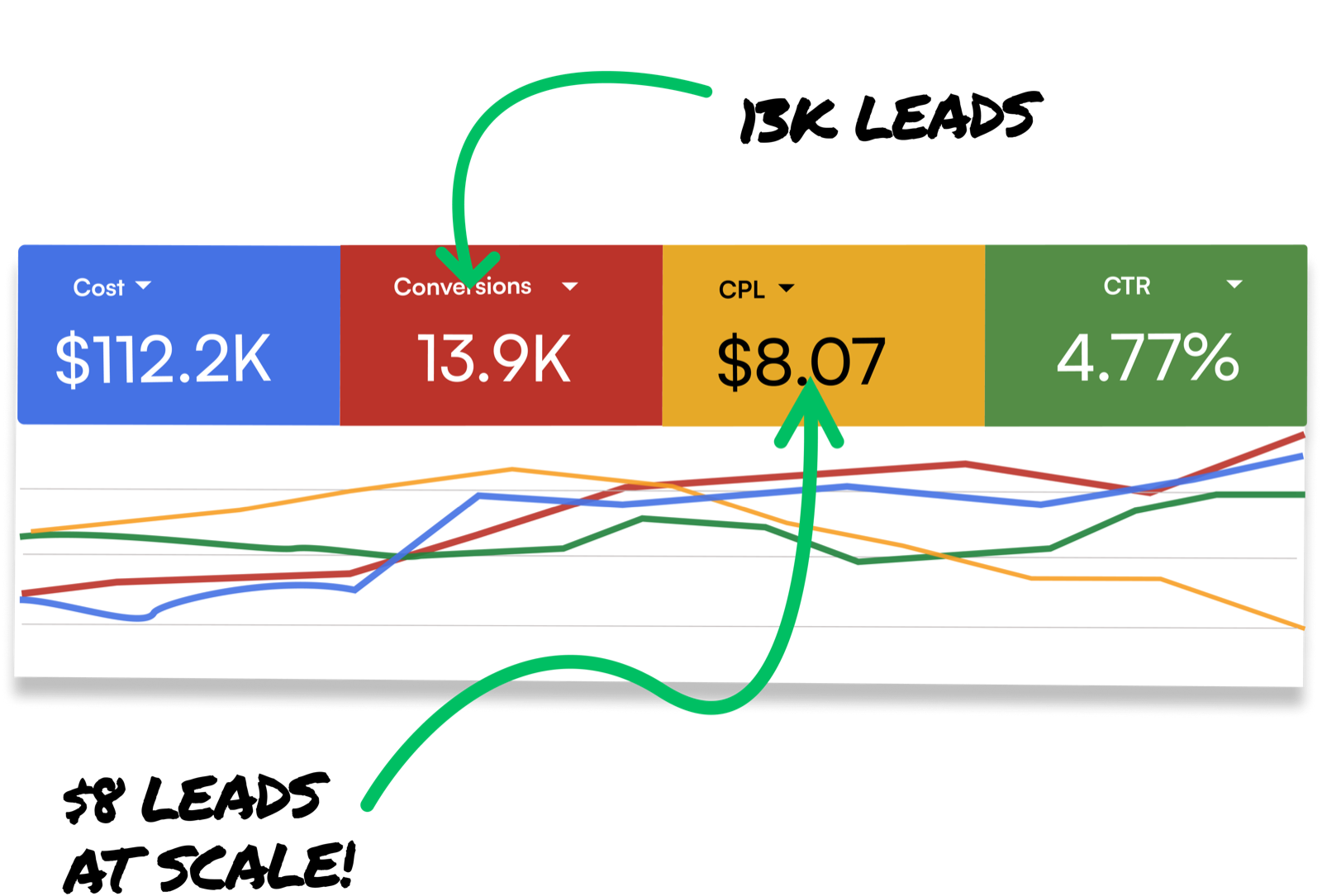
13.9K leads at $8.07 each.
- Ad spend
- $112.2K
- Leads
- 13.9K
- Cost per lead
- $8.07
- Click-through rate
- 4.77%
Most campaigns get dearer as they grow. This one averaged an $8 cost per lead across more than $100K of spend.
If your ad sounds like every other business in your industry, the cheapest one wins. (Fun race. Nobody finishes it rich.) We build an offer so specific that price stops being the question, and suddenly every ad, page and sales call gets easier.

If any of these sound like your business, put the agency’s phone number down for a sec. Your ads probably aren’t the problem.
“Our ads look like everyone else’s.”
Quality service, competitive prices, call today. Cover the logo and your own mum couldn’t pick which one was yours.
“People ask for a quote, then disappear.”
Without a clear reason to choose you, the quote becomes the only thing they compare, and somebody is always cheaper.
“We’ve tried every agency and nothing sticks.”
New logo on the report, new creative, same result. The offer underneath never changed, so neither did the numbers.
“We don’t really know what a customer is worth.”
Which makes it very hard to know what you can afford to pay to get one, so every budget decision is a guess.
Your offer is the first domino. It decides how many people stop scrolling, how many fill in the form, how many turn up to the call and how many say yes at the end of it.
Get it wrong and you pay for it at every step, every month, for as long as you advertise. Get it right and every other part of your marketing gets cheaper without anyone touching the targeting. (Your agency won’t tell you this, because it doesn’t involve a bigger ad budget.)
A sharper offer gets more people to click, and more of those people to put their hand up. That halves the cost of every lead before anyone has touched the targeting.
| Measure | Today | Fixed |
|---|---|---|
| Monthly ad budget | $5,000 | $5,000 |
| People who click | 1,000 | 1,500 |
| Leads | 30 | 60 |
| Cost per lead | $167 | $83 |
Illustrative numbers to show how the maths works. Not a client result or a promise of one.
Drop any one of them and the leads leak out the gap. Most businesses have a couple of these covered on a good week. We run all six, on one team, against one scoreboard.
Quoting against three competitors and losing to the cheapest one.
Prospects who have already decided they want you, asking when you can start.
Setting the ad budget by gut feel and hoping for the best.
A number you can trust: what a customer is worth and what you can afford to pay to win one.
Switching agencies every year in the hope the next one gets it.
An offer that works on every channel you put it on, whoever runs it.
Every agency has a slide deck. Here are real dashboards from campaigns our team has run. (Screenshots, not stock photos of people pointing at laptops.)
Get numbers like theseMost campaigns get dearer as they grow. This one averaged an $8 cost per lead across more than $100K of spend.
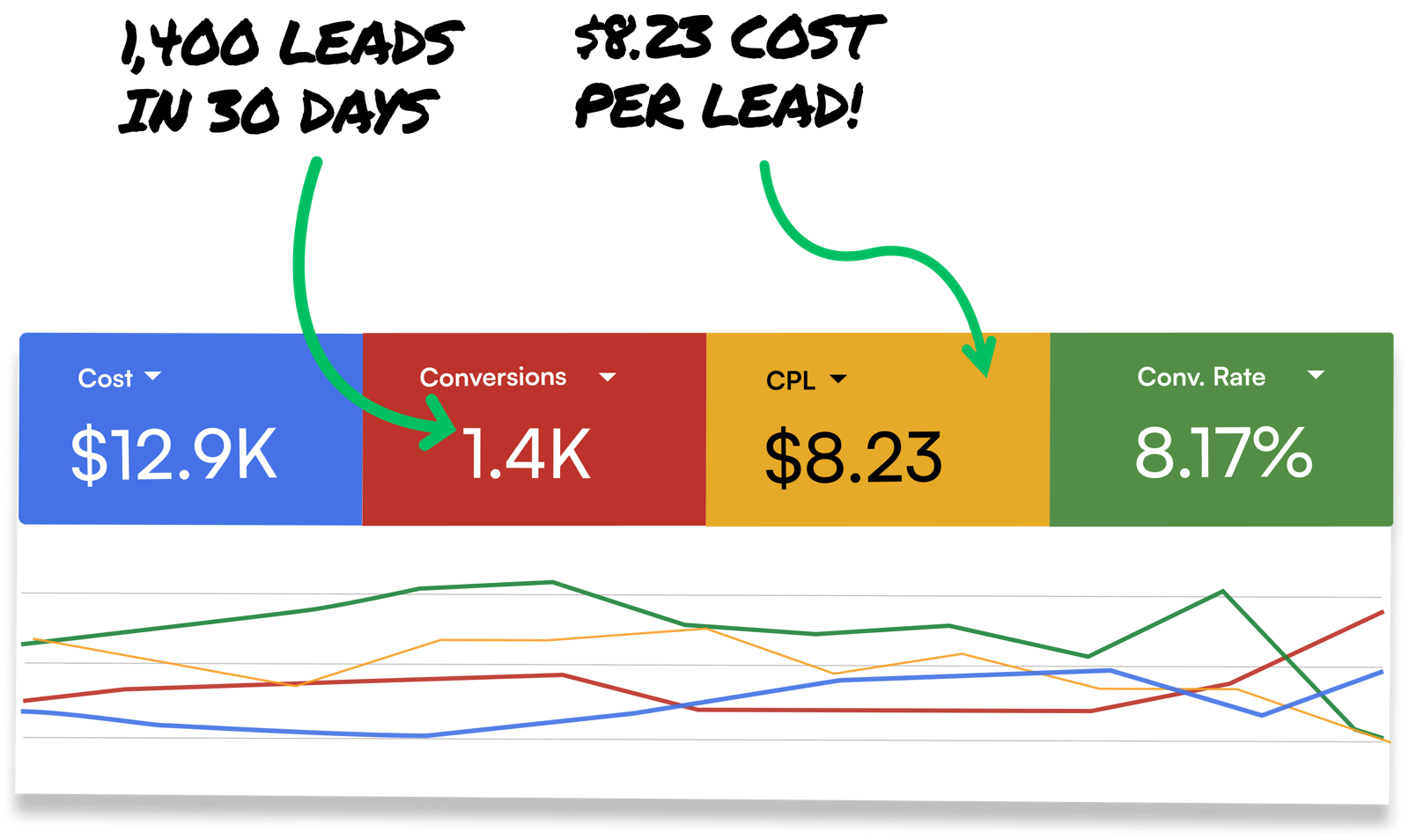
One of the most crowded ad markets in the country, and this campaign still brought leads in at $8.23 each.
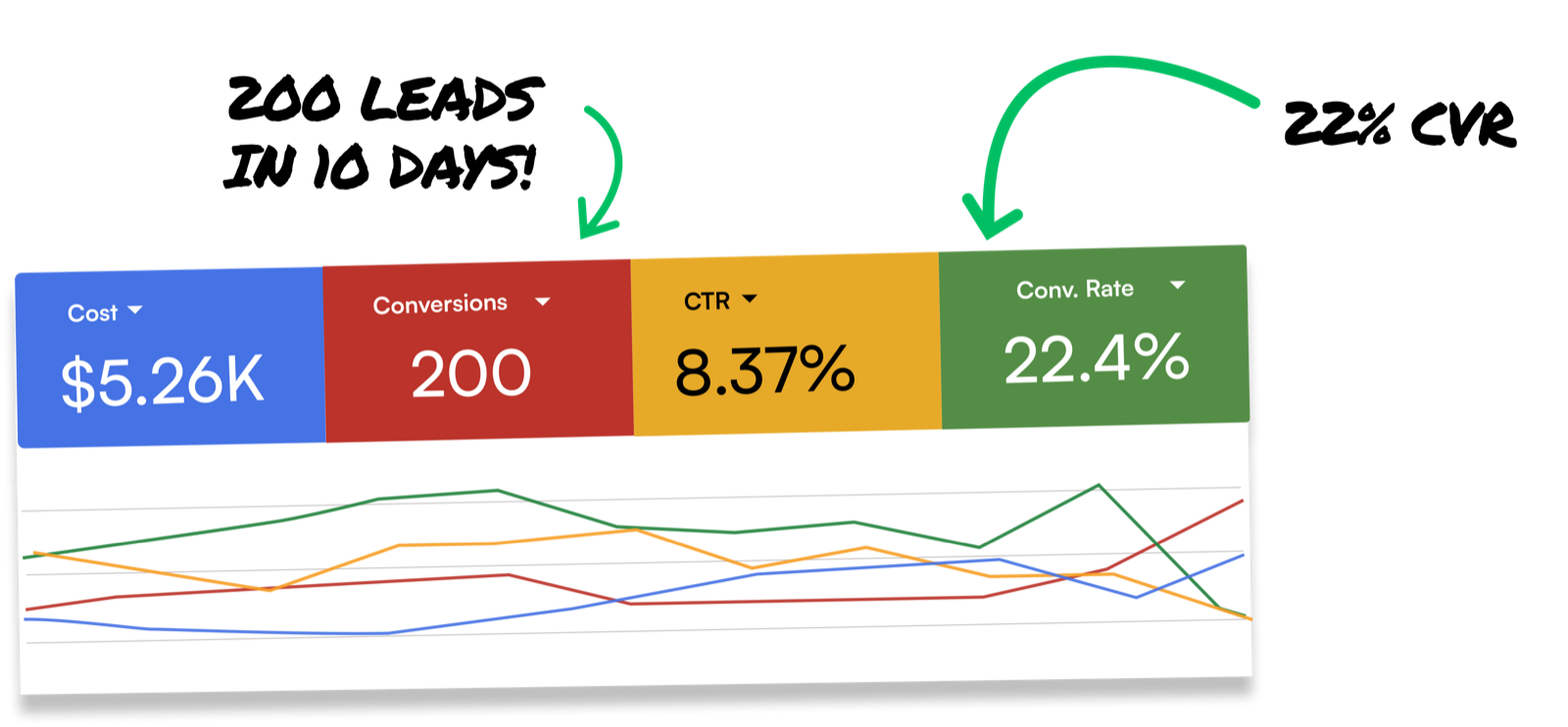
More than one in five people who clicked became a lead. That’s what happens when the ad, the offer and the page all agree with each other.
It’s the first thing we build for every client, because a better offer makes every ad, page and sales call after it cheaper.
We dig into your best customers: why they bought, what nearly stopped them and the exact words they use.
So your ads sound like your customers, rather than a brochure.
A specific result, a timeframe and a reason it’s safe to say yes, with guarantees and bonuses where they make sense.
So the question becomes “when can you start” instead of “who’s cheapest”.
What a customer is worth, what you can afford to pay for one and the numbers each campaign has to hit.
So you know exactly when it’s safe to spend more.
Which platforms, which audiences, what budget and what we test first.
So your first dollar goes where it’s most likely to come back.
Got a question about Offer & Strategy that isn't here? Bring it to the strategy call and you'll get a straight answer.
If your offer is already strong, we’ll tell you so and move straight to campaigns. If it isn’t, running more ads will just buy you more expensive tyre-kickers.
No. We change how it’s packaged and presented, meaning the promise, the proof and the risk reversal. What you actually deliver stays yours.
Usually a couple of weeks, depending on how quickly we can talk to you and a few of your customers.
Some of your time, any customer feedback or reviews you’ve got and, ideally, a few customers who are happy to have a quick chat with us.

Direct-response Facebook and Instagram campaigns, with hooks and angles tested every week to bring down what each customer costs you.

Search and Performance Max campaigns that catch buyers while they’re actively looking, tracked all the way through to revenue.

Landing pages, VSLs and lead forms built to turn the traffic you’re already paying for into enquiries.
Scaling a business with paid ads is hard. You can throw money at Meta and Google, but without a system, you're just burning cash. Most businesses waste 40-60% of their ad spend on leads that never convert — not because the ads are bad, but because there's no process to close them.
That's where Response Boss comes in. We don't just build ads. We build entire customer acquisition systems. We take control of your campaigns on Meta and Google, design them for conversions, then work with your sales team to make sure every lead that comes through actually closes.
Our approach is simple: strategy first, then execution, then relentless optimization. We audit your current ads and sales process, identify the gaps, and build a machine that turns strangers into customers. It's the same system used by the fastest-growing businesses in Melbourne and beyond: clear strategy, proven tactics, and accountability for results.
Whether you're doing $100k or $1M in revenue, the problem is usually the same — you need more qualified leads, and you need your team trained to close them. We handle both.